This week, we had a four-slide TikTok photo post ready to go. The YouTube channel was connected too. Checking one more box would have taken seconds.
We didn’t.
The TikTok post was built to be swiped. Each slide held one step, and the reader controlled the pace. Exporting those four images as an MP4 would have produced a file YouTube could accept as a Short, but it would not have made it a good Short. The viewer would lose control of the reading speed, while we would gain nothing except another published URL.
That is the part most cross-posting advice misses. The hard question is not, “Can this file go to another platform?” It is, “Will this idea still make sense in the way people use that platform?”
Cross-posting is not lazy. Copy-pasting without making that decision is.
Should you post the same content on every platform?
Sometimes — when the audience expectation and the way people consume the post are already close. Otherwise, reuse the idea, not the finished post.
The standard warning is “never post the same thing everywhere.” It sounds serious and is almost useless because it pushes creators toward the other bad extreme: rebuilding everything from zero.
If you create a completely original idea, script, shoot, edit, caption, and schedule for every network, you will either need a content team or quietly abandon half the networks. Sprout Social reports that 87% of the marketers it surveyed plan to expand to more networks in 2026; the same report frames that expansion against tighter budgets and lower head counts.
The opposite approach is no better. One asset goes everywhere, unchanged. The Instagram caption still says “link in bio” when it lands on Facebook. A thoughtful LinkedIn post gets squeezed into X. A TikTok carousel becomes a slow YouTube slideshow. Distribution increases, but usefulness does not.
You do not need unique ideas for every platform. You need one idea and an editorial decision for each destination.
Use two questions, not ten platform checklists
Before adding a platform, ask:
-
Does the audience on this account expect this kind of idea from us?
-
Is the content already in a native consumption format for that platform?
Those two answers produce four practical choices.
| Audience expectation | Consumption format | What to do |
|---|---|---|
| Similar | Native | Reuse the asset and adjust the packaging |
| Different | Native | Adapt the hook, angle, language, or CTA |
| Similar | Not native | Rebuild the asset around the same idea |
| Different | Not native | Skip the platform this time |
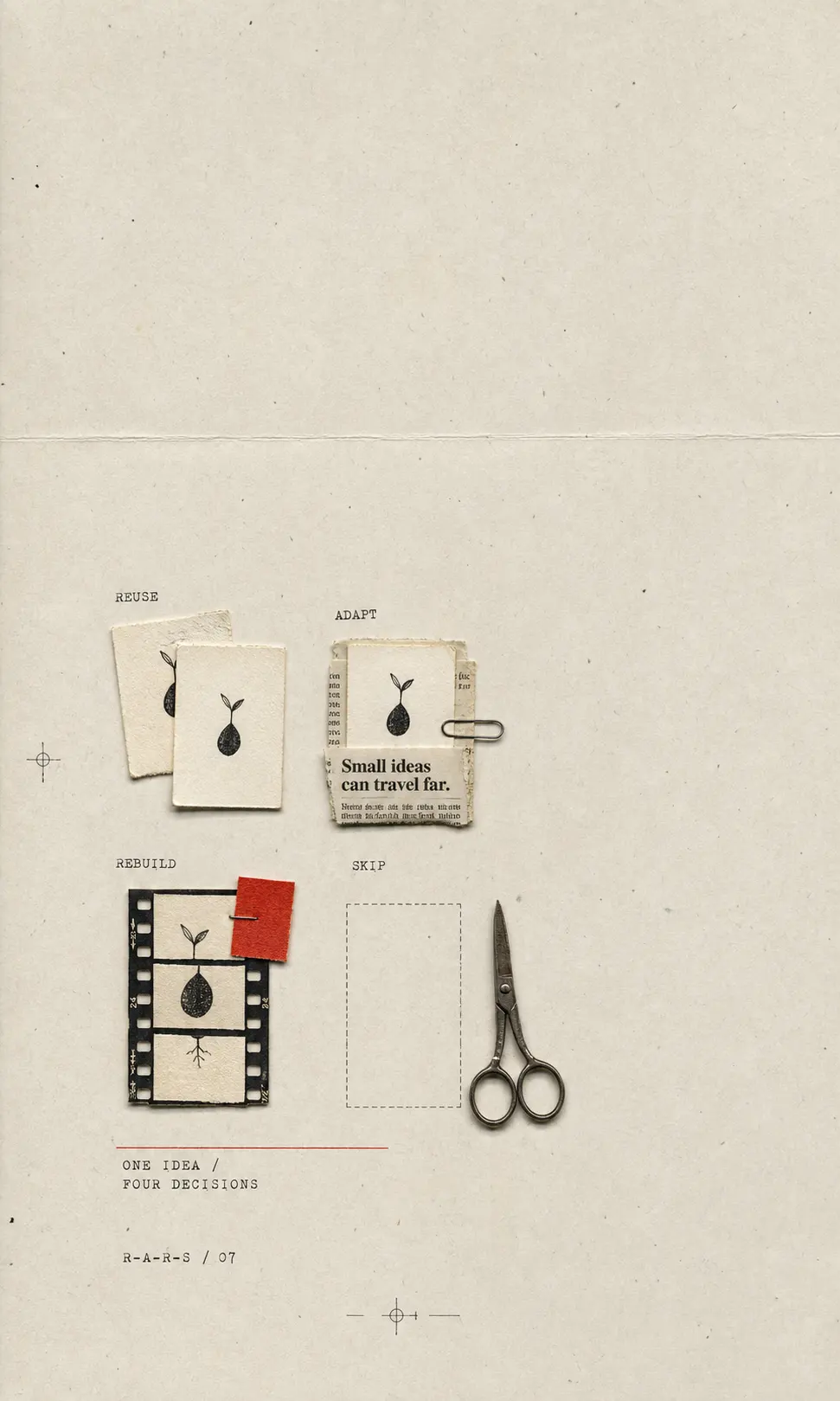
One idea can be reused, adapted, rebuilt, or deliberately skipped depending on the destination.
This is deliberately not a rule about platform demographics. Platform averages are only a starting hypothesis. Your own account may have a very different audience from the network stereotype, and your analytics should win that argument.
The questions are about this account, this audience, and this post.
Reuse when the viewing behavior already matches
Reuse means the core media can stay intact. It does not mean every field stays identical.
A clean vertical product demo may work across TikTok, Instagram Reels, YouTube Shorts, and Facebook Reels. The viewer is watching a short vertical video in each case. You may still change the opening text, caption, audio, title, hashtags, and publishing time, but you are not rebuilding the story.
This is the cheapest kind of cross-posting, and it is where scheduling tools are genuinely helpful. Buffer’s current cross-posting guide groups platforms by compatible media types for the same reason: start where the content behavior overlaps.
Even here, watch for leftovers. Visible watermarks, platform-specific stickers, “comment below on TikTok,” or a cropped caption can make a technically valid post feel second-hand.
Adapt when the format works but the audience arrives for something else
Sometimes the asset is fine and the framing is wrong.
Imagine a founder sharing the same product lesson on LinkedIn, Threads, and X. It can remain a text post, but the same paragraph is unlikely to do equal work everywhere.
On LinkedIn, the lesson may need business context, a clear point of view, and the cost of getting it wrong. On Threads, a conversational observation may invite a better response. On X, the sharpest claim might deserve the first line, with the detail moved into a thread.
The idea has not changed. The reason someone should care has.
Adaptation usually means changing four things:
-
the hook
-
the amount of context
-
the proof or example
-
the next action you ask for
If you are changing fonts and dimensions while leaving those four untouched, you are decorating, not adapting.
Rebuild when the audience fits but the consumption mode does not
This is where our TikTok and YouTube example landed.
The idea — a three-step system for posting consistently — fits creators on both platforms. The asset does not. A TikTok photo post lets someone swipe, pause, and move back. A YouTube Short sets the pace for them.
YouTube says its Shorts systems look at whether viewers choose to watch, whether they stay, average view duration, and average percentage viewed when ranking content. That does not mean image slideshows are automatically punished. It means pacing is part of the product, not an export setting. YouTube explains those signals directly in its Shorts discovery guidance.
The YouTube version should therefore keep the idea and rebuild the delivery: spoken narration, moving B-roll, timed captions, and a payoff that arrives before the viewer swipes. It is not “extra content.” It is the YouTube-native version of the same work.
Other common rebuilds look like this:
-
a blog becomes a LinkedIn document carousel, not a pasted 1,500-word caption
-
a webinar becomes three short clips, not a 48-minute upload to every feed
-
a text thread becomes a visual Pinterest guide, not a screenshot of the thread
-
a customer quote becomes a short story on LinkedIn and a visual proof card on Instagram
Rebuilding costs more than adapting. That is exactly why Skip is a legitimate fourth option.
Skipping a platform can be the most disciplined choice
More platforms do not automatically create more reach. They create more chances to be relevant — or more chances to look misplaced.
Skip when the idea has weak audience fit and would also require a new format. The work is now closer to creating a separate post than distributing an existing one. Unless that platform is strategically important, spend the effort on the version with the strongest fit.
This is not a permanent verdict on the network. It is a decision about one piece of content.
A photo carousel can stay TikTok-only today. The underlying lesson can become a YouTube Short next week when it has a script and footage worth watching. Nothing was wasted; the idea moved into a backlog instead of being forced through a file converter.
What automation should actually handle
The repetitive parts of cross-posting are real:
-
keeping each platform version attached to the same idea
-
validating media and platform requirements
-
scheduling different versions at different times
-
routing a draft for approval
-
tracking what went live and what failed
Those are good automation jobs.
Audience judgment is not. A tool can tell you that YouTube accepts one video. It cannot turn four static slides into a worthwhile Short by changing the file extension. AI can suggest a shorter caption. It cannot know whether your LinkedIn followers care about the same angle as your TikTok viewers without account context and performance data.
That boundary matters to us because Solnk sits inside this workflow. One publish can keep per-target copy, media, and platform settings together. When variants also need different times, create separate scheduled publishes for those times. The useful part is not one button that sprays an identical post everywhere. It is having the versions in one place after you have made the editorial call.
If you only need to copy one good post to two compatible feeds, use the simplest tool available — including the platforms’ own cross-posting features. If you are managing several adapted versions, Solnk can hold and schedule them without turning them back into one generic post.
The goal is not to publish everywhere. It is to carry a useful idea as far as it can travel without pretending every destination is the same place.